Have you ever stood soaked on deck wondering why your “waterproof” jacket still let the rain through? At sea, clothing isn’t just a matter of style, but a guarantee of your comfort and safety. In this guide, we clarify what the numbers on the labels mean and which fabric suits your adventures best.
Waterproofing and Breathability: The Science of Membranes
Modern sailing clothing has come a long way from the days when sailors wore heavy and cumbersome oilskins. At the heart of modern gear are membrane fabrics, like the renowned Gore-Tex or Pelle P Hi:res® technology. These materials are designed to work similarly to your skin: they don’t let external water in but allow body moisture and sweat to evaporate. This is a critical feature because if moisture gets trapped under clothes, the body starts to cool down regardless of the jacket’s thickness.
Historically, Henri-Lloyd was one of the pioneers to introduce taped seams and non-corrosive nylon zippers. This innovation permanently made marine clothing lighter, more durable, and more waterproof, replacing earlier lacquered clothing with the technical excellence we enjoy today.
What to Look for on Product Labels?
When choosing a jacket from our sailing category, it is worth paying attention to two main indicators: water column and breathability. The water column is measured in millimeters and indicates the material’s water resistance under pressure. A range of 5,000–10,000 mm is perfect for light rain and coastal walking, while 10,000–20,000 mm is a good choice for coastal sailing in changeable weather. For serious offshore sailing and extreme conditions, the number should exceed 20,000 mm.
Breathability is just as important, indicating how much moisture the fabric lets through. The more active the activity on board, such as hauling sheets during a race, the higher the breathability number should be. Our women’s sailing clothing and men’s sailing clothing offer options reaching up to 30,000 mm waterproofing, ensuring maximum protection even in the harshest storms.
Raincoats and Urban Style
You don’t always need a storm-proof membrane. If you are looking for something simpler for a rainy walk on the quay or in the city, PU (polyurethane) coated fabrics or EVA material are excellent choices. These materials are completely waterproof and very easy to maintain. Although their breathability is lower than technical sailing jackets, they offer excellent protection against downpours and a stylish look for everyday wear.
Windproof Knitwear: Innovation in Heat Retention
At sea, wind is often a greater enemy than water, because strong wind cools the body many times faster than just low temperature. A regular wool sweater is warm, but the wind blows right through it. This is where products from the Windproof category come to the rescue, combining classic style with modern technology.
The secret of these knits lies in the lining. The outer layer of the sweater is often made of high-quality wool or cotton blend, but underneath hides an elastic and breathable lining that is completely windproof. This technology allows you to enjoy the traditional sailor look without having to wear a separate shell jacket to stay warm. It is the ideal solution for chilly evenings both at sea and on land.
Insulation: Down vs. Synthetic
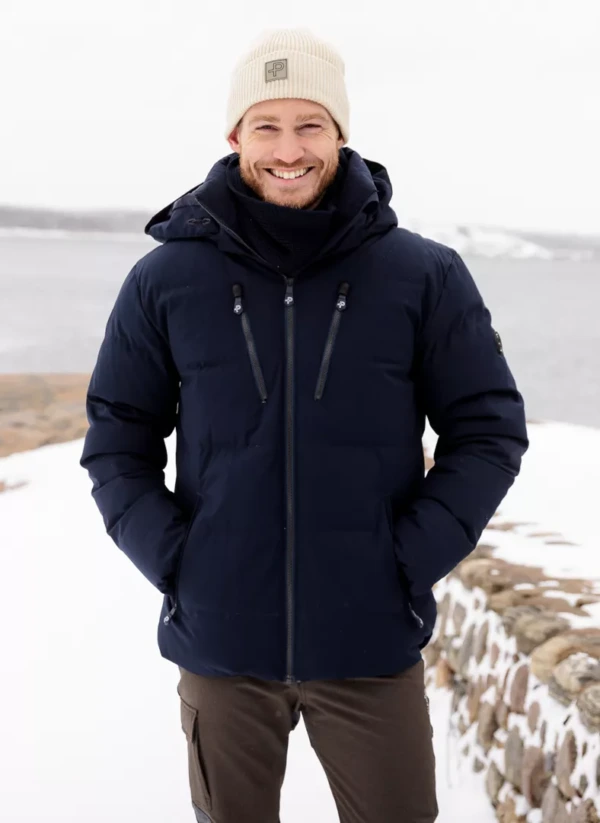
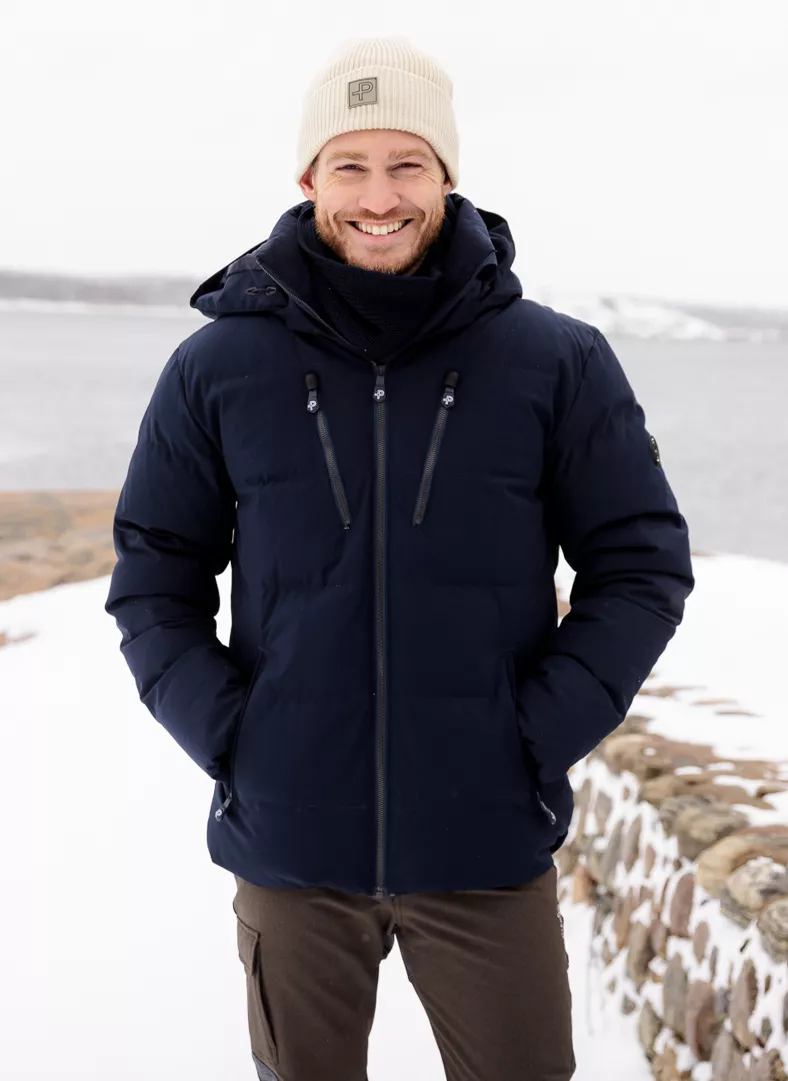
In colder weather or during the early spring season, a proper thermal layer is necessary under women’s technical clothing and men’s technical clothing. Here, the choice is mostly between down and synthetics. Down offers an unbeatable warmth-to-weight ratio, being ideal for dry and cold weather.
Synthetic insulation, such as Primaloft or Sorona, mimics the properties of down but possesses a critical advantage at sea: it retains heat retention even when the material gets wet. Since moisture is always a factor at sea, jackets and coats with synthetic filling are often a more practical choice for the active sailor who doesn’t want to worry about weather conditions.
Special Purpose Materials: Neoprene and Merino Wool
The layers closest to the body largely determine your comfort level. An old truth says that cotton is undesirable at sea as it absorbs moisture and cools the body. Instead, the best choice is merino wool. This miracle of nature keeps you warm even when wet and is naturally antibacterial, meaning clothes stay fresh longer even on long sea voyages.
Another indispensable material, especially if there is a risk of falling into the water or if there is a lot of spray, is neoprene. Neoprene acts as an insulator, trapping a thin layer of water or air in the material’s pores, which is then warmed by body heat. This makes neoprene products ideal for dinghy sailors or those sailing in colder conditions.
How to Care for Your Gear?
High-quality marine clothing is an investment that serves you for years if cared for correctly. Improper washing can ruin the waterproof layer or clog the breathable membrane, turning an expensive jacket into an ordinary plastic bag. The first and most important rule is salt removal: rinse clothes with fresh water immediately after sailing, as salt damages fabrics and zippers. Warm water dissolves salt crystals better than cold water.
Be careful when washing. Wash waterproof clothing on a gentle cycle (up to 40°C) and use a detergent specifically designed for technical clothing. Never use fabric softeners, as they break down the fabric’s waterproof coatings (DWR) and UV protection. After washing, it is recommended to dry the clothes in a tumble dryer at a low temperature (if the care label permits), as heat helps restore the fabric’s water-repellent properties. However, wash neoprene products by hand and dry them in the shade so the sun doesn’t make the material brittle.
Regardless of whether you choose gear from our women’s category or men’s category, knowing the material properties is the first step towards a more enjoyable sea voyage. With the right gear, every weather is sailing weather.